

Overview
Lovable.dev is an AI-powered app-building platform designed to help builders turn ideas into production-ready software using natural language. In less than two months after commercialization, Lovable reached $10M in ARR, becoming the fastest-growing startup in Europe.
They scaled without relying on a traditional sales-led motion or any heavy paid acquisition. Instead, growth was embedded directly into the product and its distribution model through open source, founder-led storytelling, community-driven adoption, and 12+ growth channels.
Lovable originated as GPT-Engineer, an open-source project created by founder Anton Osika. The repository rapidly gained traction, surpassing 50,000 GitHub stars and becoming one of the fastest-growing projects on GitHub. By the time Lovable launched as a commercial product, demand was already established, with 27,000 users on the waitlist and a highly engaged developer audience across GitHub, X, Reddit, and Discord.
Lovable’s growth and execution culminated in a $330M Series B round at a $6.6B valuation, validating not only the product but the effectiveness of its open-source-led, founder-driven go-to-market system.
This case study examines how Lovable aligned open source, community, product quality, and founder-led distribution into a repeatable growth engine, and how that system enabled one of the fastest ARR ramps in European startup history.
Want to build a growth engine like Lovable’s ?
Initial Challenges Lovable Faced
Yes, Lovable scaled quickly, but that doesn’t mean they didn’t face any challenges initially.
They had to navigate a set of foundational challenges common to AI-first B2B SaaS platforms, amplified by their speed of execution and growing user base.
First, the data quality was critical, and Lovable’s ability to generate reliable, production-ready applications depended on high-quality training data and continuous feedback loops. Inconsistent or low-signal data risked undermining model accuracy and developer trust, particularly as usage expanded across diverse use cases.
The second challenge was that ethical considerations became increasingly important as adoption grew. Building AI systems capable of writing code and generating application logic requires deliberate safeguards to minimize bias, enforce fairness, and ensure responsible outputs. The startup needed to balance rapid iteration with careful oversight to avoid unintended behaviors in real-world deployments.
Finally, maintaining user trust at scale was non-negotiable. Developers and businesses entrusting Lovable with application logic and workflows expect transparency, reliability, and strong security practices. Protecting user data, ensuring predictable system behavior, and clearly communicating how the platform worked were essential to sustaining long-term adoption.
Growth System Overview: Embedded, Parallel, and Compounding
Lovable’s approach was fundamentally different from a linear channel strategy. Instead of testing channels sequentially, Lovable activated 12+ growth channels simultaneously, allowing them to reinforce one another and compound momentum. These included:
- X (Twitter)
- Discord
- YouTube
- SEO / Google
- Partnerships
- GitHub
- Product Hunt
- Podcasts
- Events
- Paid Ads
- Hackathons
Every channel boosted another: open-source virality drove socials; community amplified launches; founder posts seeded SEO value; and so on.
To understand how all these channels worked together, we need to start where Lovable’s growth actually began:
1. Open Source as the Growth Foundation
Lovable began as GPT-Engineer, an open-source project created by Founder Anton Osika.
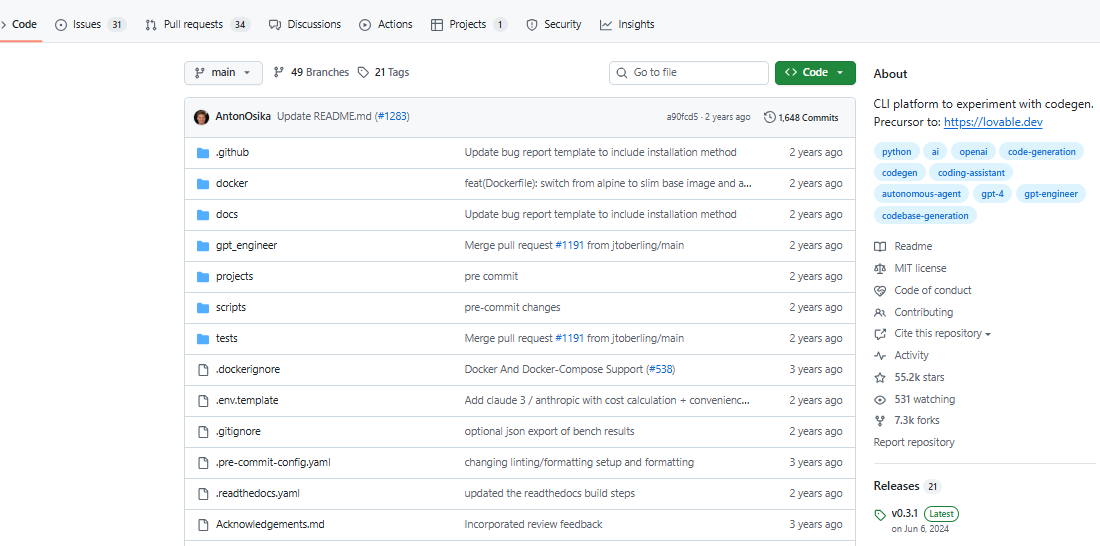
- The repository went viral, reaching 50,000+ GitHub stars
- It became one of the fastest-growing repositories on GitHub
- Developers actively shared experiments across GitHub, X, and Reddit
- The project built immediate trust and credibility within the developer community
By the time Lovable launched commercially:
- The team already had a large, engaged audience
- 27,000 users were on the waitlist
Open source functioned simultaneously as pre-launch marketing, distribution, and R&D. Lovable did not need to introduce itself to the market; the market already knew and trusted the project.
2. Product Hunt as a Repeatable Growth Lever
In parallel with GitHub momentum, Lovable used Product Hunt as a repeatable distribution mechanism, not a one-time launch event.
- GPT-Engineer launched on Product Hunt in early 2024
- Reached top positions
- Received 522 upvotes
- Lovable (standalone product) was later launched on Product Hunt
- Received 1,356 total upvotes
- Ranked #1 Product of the Day
- Ranked #1 Product of the Week
- Ranked Top 5 Product of the Month
Product Hunt was used strategically to create recurring spikes in traffic, credibility, and user acquisition, reinforcing the existing open-source momentum rather than replacing it.
3. X (Twitter) as the Primary Founder Distribution Channel
Founder Anton Osika used X (Twitter) as a daily distribution channel. His posts regularly included:
- Product updates and demos
- Growth metrics and milestones
- User-generated content
- Launch announcements and feature releases
In the following image below, you can see how the Founder shared the growing success of Lovable, becoming the fastest-growing startup in the history of Europe.
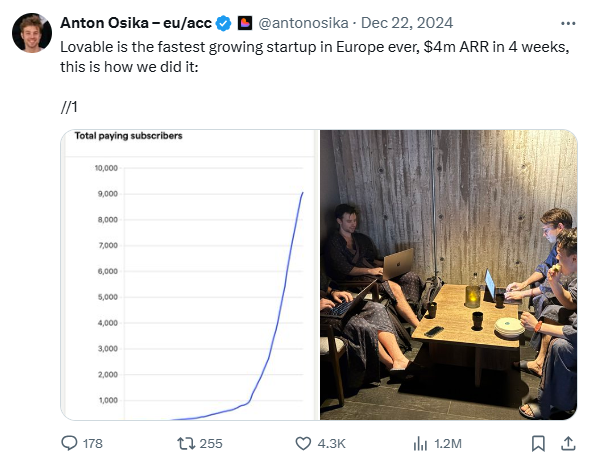
Their approach resulted in:
- Continuous visibility in the builder ecosystem
- Social proof through transparent growth sharing
- A strong founder–product association
Lovable’s growth on X was founder-led, and the product spread through the founder’s credibility, narrative, and real-time product updates rather than paid amplification.
4. LinkedIn for Professional and B2B Credibility
LinkedIn followed a strategy similar to X, adapted for a professional audience. The content focused on:
- Growth milestones
- Product vision and long-term mission
- Startup-building updates
- Investor- and operator-focused insights
LinkedIn allowed Lovable to extend trust beyond developers, reaching enterprise users, investors, and operators, and reinforcing legitimacy at later stages of adoption.
Want to build a growth engine like Lovable’s ?
5. SEO as a Secondary Growth Engine
Lovable invested in SEO by publishing content related to the following:
- Its own growth journey
- Product use cases and tutorials
- AI app-building workflows
The platform used its own growth story as content. Growth itself became a marketing asset, attracting organic traffic and signups without traditional demand-generation tactics.
6. Partnerships to Accelerate Distribution
Lovable partnered with agencies and independent builders using a structured incentive model:
- Agencies received Lovable at a discounted rate
- Agencies used Lovable to build software for their clients
- Agencies earned commissions on recurring revenue
This model converted agencies into incentivized distribution partners, extending Lovable into real client projects without building a traditional sales team.
7. YouTube for Long-Form Product Education
YouTube, although it wasn’t a primary community for growth, played a supporting role in Lovable’s growth strategy. It generated thousands of views per video. Youtube gave Lovable:
- 20,000+ subscribers
- Thousands of views per video
- Content focused on product demos and tutorials
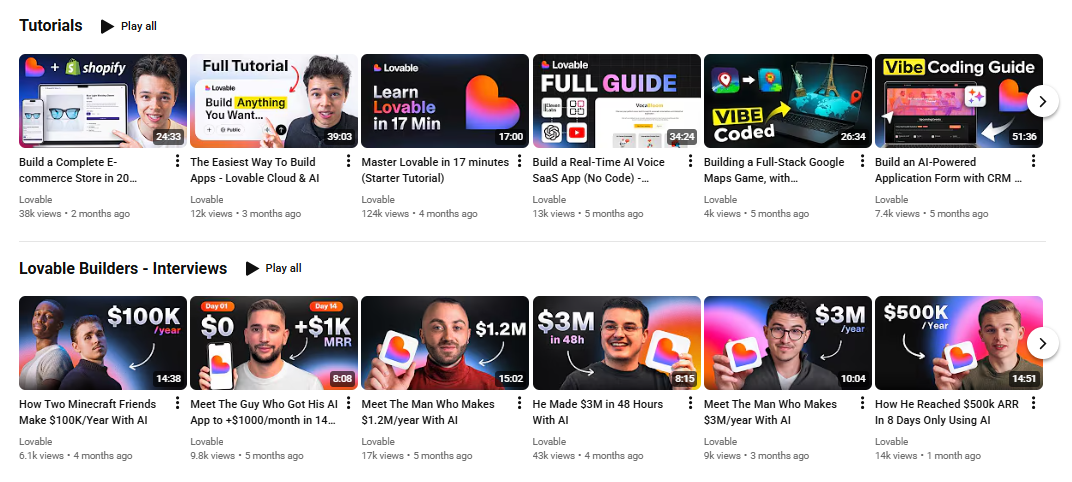
YouTube primarily supported education, trust, and retention, rather than immediate acquisition.
8. Discord as the Community Backbone
Lovable built and maintained a large Discord community with 151,000+ members. Discord was used for:
- Product feedback
- User support
- Community-led learning
- Power users helping new users
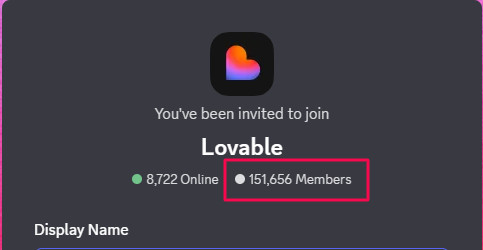
Discord reinforced retention and converted users into advocates by embedding collaboration and support directly into the product ecosystem.
9. Paid Ads as a Scaling Layer
Lovable prioritized organic growth initially and introduced paid ads later to scale proven demand. Ad channels included:
- YouTube Ads
- Google Search Ads
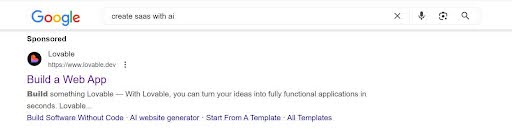
These paid ads were used to scale validated demand, not to discover product-market fit.
10. Reddit for High-Intent Discovery
Lovable appeared in multiple Reddit threads showcasing:
- Real examples of what could be built using Lovable
- Practical demonstrations rather than marketing claims
Reddit drove high-intent, high-quality traffic by focusing on usefulness and real outcomes instead of promotion.
11. Podcasts for Authority and Trust
Anton Osika appeared on several prominent tech podcasts, including:
- 20VC (Harry Stebbings)
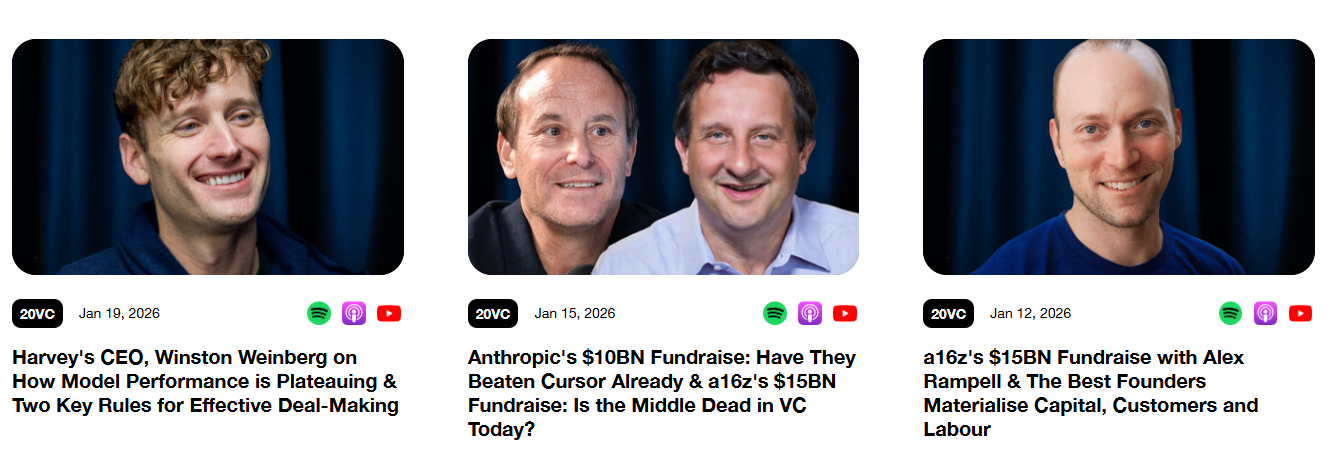
- Lenny Rachitsky
- Cognitive Revolution
- This Week in Startups
- Brett Malinowski
Podcasts enabled long-form storytelling, building trust with founders, operators, and investors at depth.
12. Events for Offline Visibility
Anton attended and spoke at events such as Slush, featuring:
- Live demos
- Founder storytelling
- Direct engagement with builders and investors

Offline presence reinforced online momentum and credibility.
13. Hackathons as an Activation Loop
Hackathons played a critical role in adoption:
- Hands-on product usage
- Rapid learning curves
- Participants sharing builds publicly
Hackathons generated user-generated content, social proof, and organic distribution loops, reinforcing awareness and adoption.
Wrapping Up
Lovable’s journey demonstrates what becomes possible when growth is treated as a system rather than a function.
From Infrasity’s perspective, Lovable did not scale because of a single breakout channel or short-term tactic. It scaled because multiple proven growth levers, open source, founder-led distribution, community, content, partnerships, and structured launches, were activated in parallel and designed to reinforce one another.
Open source laid the foundation by establishing trust and early demand long before commercialization. Founder-led storytelling on X and LinkedIn ensured continuous visibility and credibility without relying on ads. Community platforms like Discord and hackathons converted users into collaborators and advocates. Repeatable Product Hunt launches created predictable momentum spikes. SEO, podcasts, events, and partnerships extended reach and durability. Paid ads were layered in only after demand was already validated.
Crucially, all of this was supported by execution speed. Lovable’s ability to ship continuously, respond to community feedback, and maintain product quality ensured that attention translated into adoption, retention, and revenue.
Infrasity sees a clear lesson in Lovable’s case: sustainable B2B SaaS growth, especially for developer-first and AI products, comes from earning trust before monetization, showing real value instead of marketing claims, and building distribution into the product and the way it’s shared.
Lovable’s rise to $10M ARR in two months is the outcome. The system behind it is the alignment of product, open source, community, and founder-led distribution, is the real takeaway.
For teams building modern B2B SaaS products, Lovable serves as a clear example of what happens when growth is embedded early, executed consistently, and supported by a culture that can keep up with demand.